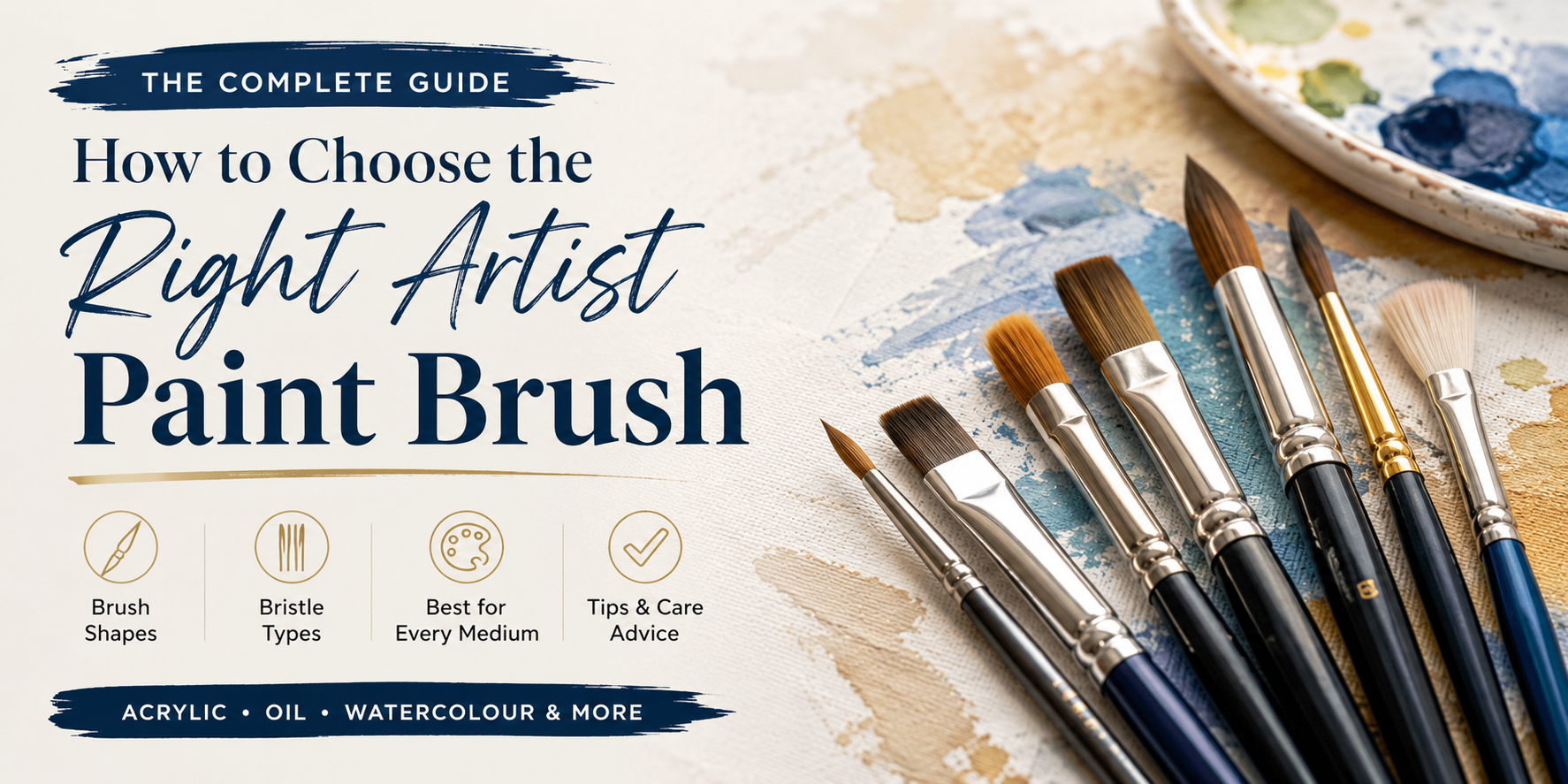
Choosing the right paint brush can make a surprisingly big difference to the way you paint. The shape of the brush affects the marks you can make, the bristles influence how much paint or water the brush holds, and even the length of the handle can change the way you work.
With so many round, flat, filbert, angled and specialty brushes available, knowing where to start can be confusing.
Whether you paint with acrylics, oils, watercolours or gouache, this guide will help you understand the main types of artist paint brushes, what they are designed to do and which ones deserve a place in your brush collection.
Explore our full range of Artist Brushes →
Understanding the Parts of a Paint Brush
Before comparing different brushes, it helps to understand their basic construction.
Bristles or hair – the working end of the brush that holds and applies paint.
Ferrule – the metal section that holds the bristles together and connects them to the handle.
Handle – available in different lengths depending on the medium and painting style.
While two brushes may look similar, differences in bristle material, stiffness, shape and construction can make them behave very differently on the painting surface.
Paint Brush Shapes Explained
One of the easiest ways to choose a brush is to start with its shape. Different shapes create different strokes and give the artist different levels of control.
Round Brushes
Round brushes have a rounded body that tapers towards a point. They are among the most versatile brushes available and are useful for fine lines, details, outlining, controlled strokes and smaller areas of colour. Larger round brushes are also commonly used for watercolour washes.
By varying the pressure, a good round brush can move from a fine line to a considerably broader stroke.
Round brushes are particularly popular for watercolour painting, although they are also widely used with acrylics and oils.
Flat Brushes
Flat brushes have a squared edge with bristles arranged in a relatively straight line. They are excellent for broad strokes, blocking in colour, painting backgrounds, creating sharp edges and covering larger areas efficiently.
Turn a flat brush onto its narrow edge and it can also produce surprisingly fine marks.
Flat brushes are especially useful when working with thicker paints such as Acrylic Paint and Oil Paint.
Filbert Brushes
A filbert combines characteristics of a round and flat brush. It has a flat body with a softly rounded tip, making it excellent for creating smooth, organic strokes without the hard rectangular edge produced by a traditional flat brush.
Filberts are particularly useful for blending, portraits, flowers, figures, soft edges and curved shapes. Many acrylic and oil painters consider the filbert one of the most versatile brushes in their collection.
Bright Brushes
A bright is similar to a flat brush but generally has shorter bristles. The shorter bristles give the artist greater control and create firmer, more deliberate marks.
Bright brushes work particularly well with thicker paint and are useful for short strokes, controlled colour application and textured painting.
Angled Brushes
An angled or angular brush has bristles cut on a diagonal. The shape allows you to alternate between broad strokes and relatively fine edges simply by changing the angle of the brush.
They can be useful for curves, edges, decorative painting, flowers and leaves, controlled shapes and areas where precision is required.
Specialty Brushes
As your painting develops, you may also come across shapes such as fan, dagger, mop, wash and liner brushes. These are designed to make particular marks or techniques easier.
A basic collection of round, flat and filbert brushes will cover a large proportion of everyday painting techniques.
Synthetic vs Natural Bristle Brushes
Synthetic Brushes
Modern synthetic brushes are commonly made from specially engineered filaments designed to provide consistency, durability and controlled spring. They are particularly popular for acrylic and watercolour painting.
Synthetic brushes generally maintain their shape well, offer consistent spring and control, work with many different painting mediums and are relatively easy to clean. They also provide an animal-free alternative to natural hair brushes.
A good example is the Princeton Velvetouch Series 3950 Premium Synthetic Blend Brush, a versatile premium synthetic blend option.
You can also explore our complete Princeton Brush Collection for brushes suited to oil, acrylic and watercolour painting.
Natural Bristle Brushes
Natural bristle brushes remain popular, particularly for traditional oil painting. Hog bristle is firm and resilient, allowing it to move heavier paint while retaining visible brush texture.
This makes hog bristle particularly suitable for oil painting, heavy-bodied paint, impasto techniques and expressive brushwork.
Explore our Oil Painting Brushes for brushes suited to traditional oil painting techniques.
Which Brush Is Best for Acrylic Painting?
Acrylic paint is extremely versatile, so there isn't one single brush that works for every acrylic technique.
For general acrylic painting, synthetic brushes are an excellent starting point. They offer enough spring to move paint effectively while providing good control. For thicker applications and expressive brushwork, firmer bristle brushes can also work very well.
A useful acrylic brush collection might contain a small round for details, a medium round, a small or medium flat, a large flat for backgrounds and one or two filbert brushes.
Browse our Artist Brushes alongside our Acrylic Paints.
Which Brush Is Best for Oil Painting?
Oil paint generally has a heavier consistency than watercolour and many acrylic techniques.
For traditional oil painting, firmer brushes such as hog bristle are popular because they can push thicker paint around the canvas without collapsing.
Flat and filbert brushes are especially useful for blocking in shapes, modelling forms and blending colours. Round brushes can then be introduced for smaller details and controlled marks.
Shop our Oil Painting Brushes and Oil Paints.
Which Brush Is Best for Watercolour?
Watercolour brushes have a different job. Instead of simply moving thick paint around a surface, a good watercolour brush needs to hold water and pigment and release them in a controlled way.
Round brushes are particularly useful because a quality round can hold a substantial amount of water while still forming a fine point. Larger brushes are useful for washes, while smaller rounds provide greater control for details.
The Princeton Snap Series 9650 Golden Synthetic Brush is one synthetic option suitable for watercolour and acrylic painting.
For artists looking for a more specialised selection, explore the Princeton Watercolor Floral Brush 5pc Set.
Browse all Watercolour Brushes, Watercolour Paints and Watercolour Paper.
Short Handle vs Long Handle Brushes
Short Handle Brushes
Short-handled brushes are generally suited to working closer to the painting surface. They are common for watercolour, gouache, illustration, detail work and smaller paintings.
They can feel similar to holding a pencil and provide excellent control.
Long Handle Brushes
Long-handled brushes are traditionally associated with oil and acrylic painting, particularly when working at an easel.
A longer handle allows the artist to stand farther from the canvas and paint with movement from the arm rather than relying entirely on the wrist. This can encourage broader, more expressive strokes.
What Do Paint Brush Sizes Mean?
One of the most confusing things for new artists is brush sizing. A Size 10 from one manufacturer may not be exactly the same dimensions as a Size 10 from another.
The number should therefore be treated primarily as a guide within a particular brush series rather than as a universal measurement. As the size number increases, the brush generally becomes larger.
Instead of focusing only on the number, consider what you actually need the brush to accomplish. Small brushes are useful for details and fine marks, medium brushes handle much of the everyday painting process, and large brushes are useful for washes, backgrounds and covering substantial areas.
Do You Need an Expensive Paint Brush?
Not necessarily. Beginners do not need twenty professional brushes to start painting.
A smaller selection of well-chosen brushes is usually much more useful than a large collection where many brushes perform almost identical jobs.
Students and beginners may want to start with an affordable brush set and discover which shapes they naturally use most often.
The Princeton Real Value Brush Sets are an easy way to build a practical starting collection.
As your technique develops, you can gradually invest in higher-quality individual brushes for the shapes and sizes you use most frequently.
A Simple Starter Brush Collection
For acrylic:
Small round, medium round, medium flat, large flat and medium filbert.
For oil:
Small round, medium flat, medium filbert and larger flat or filbert.
For watercolour:
Small round, medium round, large round and a larger flat or wash brush.
From there, add specialist shapes only when your painting style requires them.
How to Look After Your Artist Brushes
Even an excellent brush will not perform well for long if paint is repeatedly allowed to dry inside the bristles.
After painting, clean your brushes promptly and pay particular attention to the area where the bristles meet the ferrule. For acrylic paint, never allow paint to dry completely in the brush. For oil painting, follow an appropriate cleaning process for the paints and mediums you're using.
After cleaning, gently reshape the bristles and allow the brush to dry properly. Avoid leaving brushes standing bristle-down in water or solvent, as this can distort the brush shape.
Good brush care can considerably extend the working life of your favourite brushes.
Finding the Right Brush for Your Painting Style
There isn't one perfect paint brush for every artist. A painter creating large, expressive acrylic works will have very different requirements from a botanical watercolour artist working on fine details.
Start by considering three things:
What medium are you using?
Acrylic, oil, watercolour and gouache place different demands on a brush.
What marks do you want to make?
Choose the brush shape according to the stroke rather than simply buying by size.
How much control or texture do you want?
Soft brushes generally produce smoother applications, while firmer bristles can create stronger, more visible marks.
Once you understand those three factors, choosing artist brushes becomes much easier.
At Art Supplies Australia, you can explore brushes for beginners, students and professional artists across a wide selection of shapes, sizes and materials.